Axlevara · guide range
The driveshaft center support bearing, explained
What the center support bearing does on a two-piece driveshaft, the vibration symptoms of a worn one, and how to order the right HB-series replacement.
- Range
- Center support bearing guide
- Catalogue
- 249 listings in the family catalogue
- Reference
- HB numbers and cross-references
Why some shafts come in two pieces
A long propshaft cannot run as one tube: at length, it whips. Vehicles with a long wheelbase therefore split the shaft in two, join the halves with a universal joint, and carry the joint on a center support bearing — the bracket bearing that bolts to the body or a crossmember and gives the middle of the shaft its support, stability and shock absorption. Every two-piece shaft has one; every one-piece shaft does without, which is the first thing to confirm before ordering.
Anatomy of the part
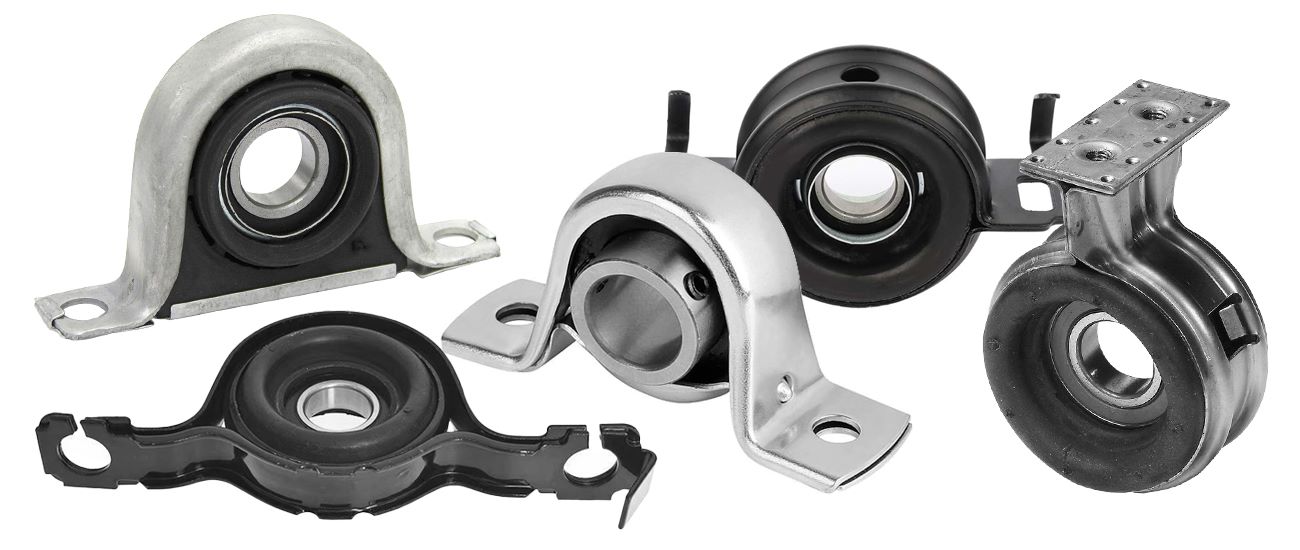
The assembly is a ball bearing inside a rubber cushion inside a steel bracket. Each element fails its own way: the bearing runs rough, the rubber perishes and sags, the bracket corrodes. Replacement is of the assembly, because the elements are supplied as one unit in the HB series the catalogue ranges.
Symptoms of a worn support bearing
The pattern is vibration that arrives with load: a shudder pulling away, a drone or thrum at cruising speed, sometimes a clunk as drive is taken up. The rubber's failure adds a visible sign — the shaft sits off-centre in the bracket, or the cushion is split. Because universal joints on the same shaft wear on the same mileage, their symptoms overlap, and the two are inspected together.
| Observation | Support bearing | Universal joint |
|---|---|---|
| Shudder on take-off | Common | Possible |
| Vibration at cruise | Common | Common |
| Shaft sagging in bracket | Yes — rubber failed | No |
| Play felt at the cross | No | Yes — joint worn |
| Squeak at low speed | Rare | Common, dry joint |
Ordering the replacement
The HB number on the old unit, or its cross-reference, is the order. The catalogue's 249 listings are held under HB numbers such as HB88107 and HB88512, with fitments that cross vehicle brands freely — the same unit serving several makers' shafts — so the number, not the badge, is the reliable reference. Where no number survives, the bracket's bolt spacing and the bearing bore narrow the match, and the desk will work from those.
Order the shaft as a system
If the support bearing has failed by mileage, the joints have lived the same life. The universal joint family is ranged alongside for exactly this reason, and the blog article on ordering the driveline pair sets out the combined check workshops run.
The pair order has a practical shape: the support bearing by its HB number, the joints by their cross-references and ring positions, quantities per position on the shaft. A shaft with two joints of different sizes — a common arrangement — needs the two sizes stated separately, because 'a pair of joints' is a description the catalogue cannot price. Stating positions the way the workshop numbers them, gearbox end and axle end, keeps the quotation aligned with the vehicle.
A last check before the inquiry
Before sending the order, confirm the vehicle actually runs a two-piece shaft. Facelifted models sometimes move between one-piece and two-piece designs across a production run, and a support bearing ordered for a one-piece car has no home. The wheelbase and the model year usually settle it; the parts catalogue's shaft drawing settles it completely.