Axlevara · compare range
Wheel bearing or hub assembly: telling the two apart
A press-in wheel bearing and a bolt-on hub assembly do the same job in different forms. The checks that tell them apart before you order.
- Range
- Cartridge bearing versus hub assembly
- Catalogue
- Two families, one wheel end
- Reference
- The old part settles the question
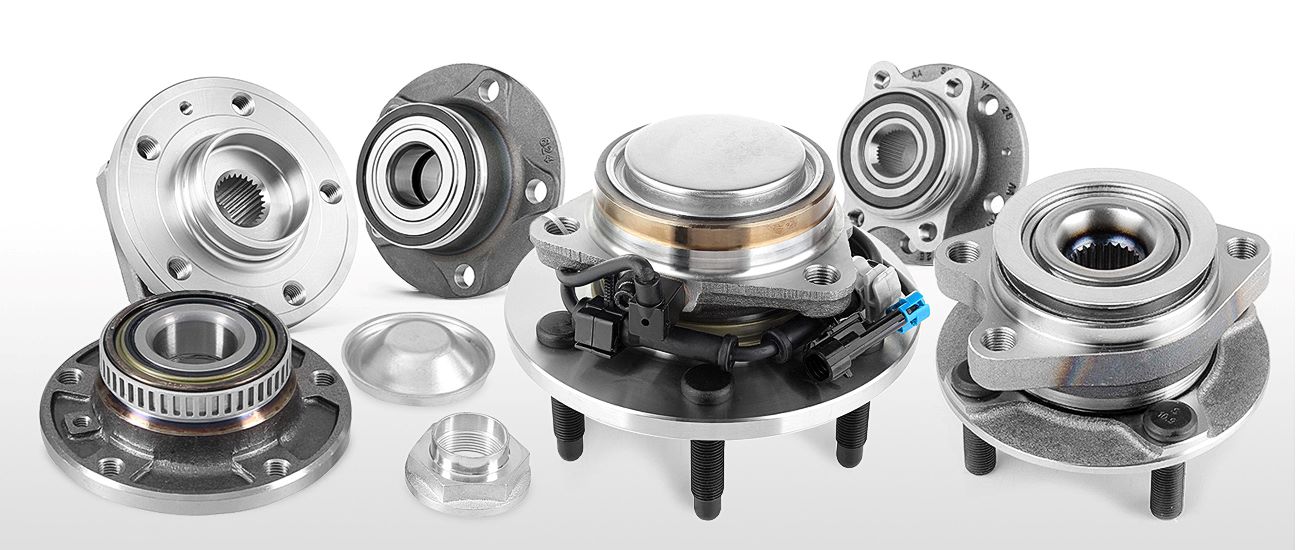
The same job in two forms
A wheel bearing and a wheel hub assembly both carry the wheel and let it rotate. The difference is construction. The bearing is a cartridge — rings, cage and rolling elements — that presses into the knuckle. The assembly is the complete bolt-on unit: bearing, flange and studs, removed and replaced as one piece. Ordering one where the car is built for the other is the most common wheel-end mistake, and it is made at the ordering desk, not at the bench.
The comparison that settles most cases
Four checks separate the two in nearly every case: how the part is fixed, what comes off with it, what the replacement job involves, and how the part is referenced. The table states them side by side.
| Check | Wheel bearing (cartridge) | Wheel hub assembly |
|---|---|---|
| Fixing | Pressed into the knuckle | Bolted to the knuckle |
| What is replaced | The bearing cartridge | Bearing, flange and studs as one unit |
| Workshop job | Press work, hub drawn through | Unbolt and refit |
| Reference | DAC code or bearing OE number | Unit OE number |
| ABS sensing | Ring or separate sensor | Gen 3 units carry the sensor inside |
Check 1: look at how the old part is held
A flanged part with bolt holes is an assembly. A plain ring with no flange is a cartridge. This sounds too simple to state, yet order errors usually start with a parts diagram rather than the old unit: diagrams flatten the difference, while the removed part shows it at a glance. Where the car is not yet stripped, the parts catalogue's exploded view for the exact model year shows whether the corner is drawn as a unit or as a bearing in a knuckle.
Check 2: the sensor question
If the wheel-speed sensor reads from the hub unit — a sensor body or lead on the unit — the car takes a Gen 3 assembly, and no cartridge bearing will close the job. If the sensor is separate, either form may be fitted, and the fixing check decides. The gen-3 series page covers the sensor arrangement in detail.
Check 3: what the vehicle was built with
Cars are built one way. A model that left production with hub assemblies does not accept cartridge bearings, whatever a general catalogue suggests; mid-production changes are the trap, and the model year — better, the OE number — is the guard. Quote the OE number and the question closes itself.
Ordering once the form is settled
Cartridge bearings are ordered from the wheel bearing family by DAC code or OE number; assemblies from the hub family by unit number. If the form is settled but the number is not, send the application and the fixing observation — 'bolted unit, sensor in the hub' is enough for the desk to return the right shortlist.
One boundary case is worth naming: some corners were built both ways across a long production run, the early cars taking a cartridge and the later cars an assembly. For those applications the model year is not a detail but the deciding fact, and an inquiry that omits it will be answered with the year question before a price. Stating the year, the fixing and the sensor arrangement together closes nearly every wheel-end identification there is.