Axlevara · guide range
Reading a wheel bearing cross reference
How OE numbers, VKBA-format kit numbers and DAC, HB and UC codes relate across the bearing catalogue — and how to send a partial reference that still gets matched.
- Range
- Cross-reference formats explained
- Catalogue
- OE, VKBA, DAC, HB and UC references
- Reference
- Partial numbers matched by method
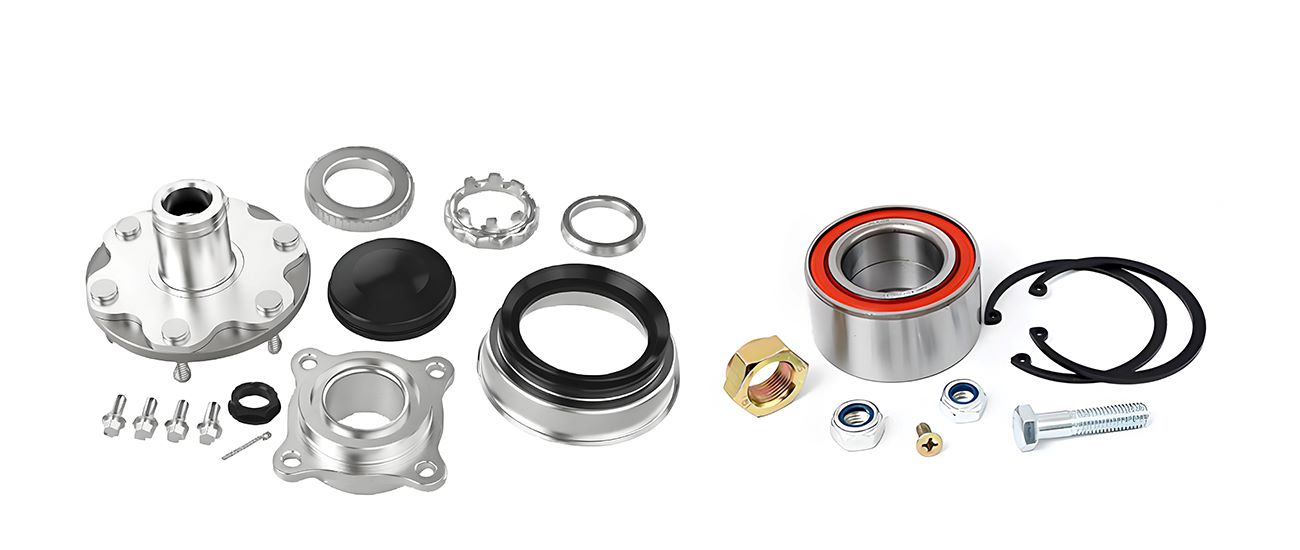
Why this range runs on references
Almost nothing in the bearing trade is ordered by description. It is ordered by reference: the OE number from the vehicle maker's catalogue, the VKBA-format number on a kit, the DAC code on a cartridge bearing, the HB number on a center support bearing, the UC code on an insert. A cross reference is the table that says these strings name the same part, and it is the working tool behind every family in the catalogue.
Vehicle brands appear in a cross reference as fitment information only. Quoting the OE number a part replaces is aftermarket practice; it is not a claim that the part comes from, or is endorsed by, the vehicle maker.
The five reference formats
Each family speaks its own format, and reading the format tells you which family a loose number belongs to before it is matched. The table is the desk's own starting point for any unidentified number.
| Format | Belongs to | Example from the catalogue |
|---|---|---|
| OE number | Bearings, hub units, assemblies | 15874836; 1J0407613J7P2 |
| VKBA-format number | Wheel bearing kits | Kit cross-references in VKBA format |
| DAC code | Cartridge wheel bearings | DAC39720037 |
| HB number | Center support bearings | HB88107; HB88512 |
| UC / UCF code | Insert bearings | UC200 / UC300 groups; UC212–UC318 span |
How the formats connect
The connections run in a chain. An OE number identifies the unit on the car. The kit that serves that corner carries a VKBA-format number, and the kit's contents name the bearing — which, if it is a cartridge, carries a DAC code. A complete reference in any one format can therefore be walked to the others, and a quotation can be given in the format the buyer's stock list uses.
Sending a partial reference
Partial references are normal and workable. A DAC code missing its last digits still gives the type and the size group. An HB number with no vehicle can be matched to its applications. An application with no number at all can be worked forwards if the generation and form are stated. What cannot be matched is a bare description — 'front bearing for a saloon' names thousands of parts.
- Send the reference exactly as printed, including suffixes
- Add the vehicle application and year if you have them
- Say whether the part pressed in or bolted on
- For hub units, say whether the sensor is in the unit
Put the method to work
Send the references you hold — complete, partial or mixed across formats — and they will be matched line by line, with the lines that need one more detail flagged rather than guessed. That flagging is deliberate: a guessed generation or a guessed kit is a return in waiting, and the cross-reference method exists to prevent exactly that.
Keep the returned match with the list it came from. The next inquiry on the same lines then starts from a settled match instead of a fresh search, and over a season a buyer's list becomes a small cross-reference of its own — the desk's answers recorded against the buyer's numbers, ready for the reorder.