Axlevara · blog range
Center support bearings and universal joints: order the pair
The support bearing and the joints share one shaft and one service life. Why the driveline is diagnosed and ordered as a pair.
- Range
- The driveline pair
- Catalogue
- Families 6 and 12
- Reference
- One shaft, one inspection
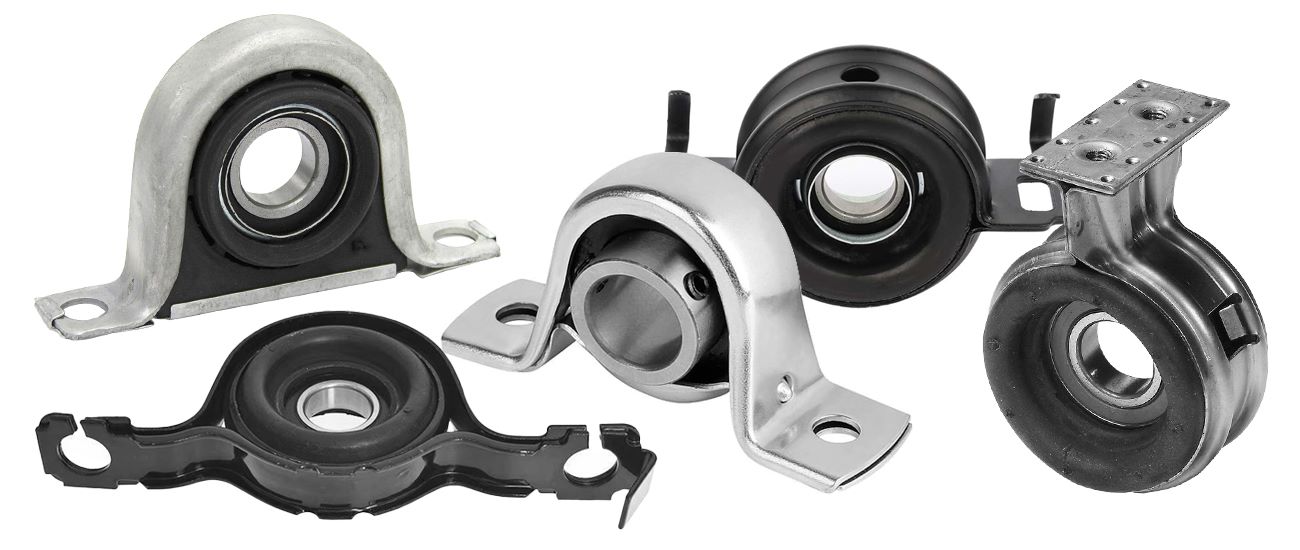
One shaft, two wear items
On a two-piece propshaft, the center support bearing and the universal joints live on the same shaft, turn the same revolutions and age on the same mileage. Yet they are often ordered separately, weeks apart, after two diagnoses of what was one vibration. This article sets out the paired approach: inspect the shaft as a system, and order its wear items together.
The symptoms, read properly, already separate the two items more often than workshops expect. A shudder that lives only in the first metres of take-off and vanishes at speed is the support's rubber collapsing under the torque reaction. A vibration that builds with speed and peaks in a narrow band is a joint running out of true. A clunk when drive is taken up or released can belong to either, and it is the one that sends the vehicle to the lift with the question still open. Reading the symptom this way does not replace the inspection — it aims it, so the lift time is spent confirming a shortlist rather than searching a whole driveline.
How the pair shares the work
The universal joints let the shaft change angle — at the gearbox, at the center, at the axle — while the support bearing carries the shaft's middle and isolates the body from its vibration through its rubber cushion. A worn joint shakes the shaft; a perished support lets it move. Either fault alone produces the driveline vibration drivers describe, and each accelerates the other: a shaking shaft hammers the support's bearing, and a sagging support misaligns the joints.
The combined inspection
With the shaft accessible, the workshop's checks pair naturally. The support: rubber split or sagging, bearing rough when the shaft is turned by hand, shaft off-centre in the bracket. The joints: play at the cross, stiffness or a notch in the swing, rust dust at the caps, a dry squeak at low speed. The driveshaft guide tabulates which observations belong to which part; the point here is that both lists are run on the same visit, because the labour of reaching the shaft is the expensive part of either job.
| Item | Check | Failure sign |
|---|---|---|
| Support bearing | Turn shaft by hand | Roughness, rumble |
| Support rubber | Visual, lever the shaft | Splits, sag, off-centre |
| Universal joints | Rock the shaft at each cross | Play, notchiness |
| Joint caps | Visual | Rust dust, dry seals |
Ordering the pair on one list
When both items are worn — the common finding on a high-mileage shaft — they go on one inquiry: the HB number for the support bearing, the cross-references for the joints, quantities per position. The two families sit side by side in this catalogue for that reason, and a combined list is quoted together so the workshop receives the shaft's parts in one delivery rather than two.
When only one is ordered
There are honest single orders: a support whose rubber has perished early on a young shaft, a joint damaged by a failed seal. The paired inspection still applies — it is what proves the other item is sound — but the order follows the finding. What the paired approach forbids is the uninspected single order, where the second fault is found a month later with the shaft dropped again.
How the vibration is read before anything is ordered
Because the pair shares symptoms, the order of diagnosis matters. A vibration that arrives under load and fades on the overrun points at the shaft rather than the wheels; a shudder in the first metres of take-off points at the support's rubber and the center joint; a steady drone at cruising speed, unchanging with throttle, suggests the support bearing itself. None of these readings is conclusive alone, and the workshops that diagnose drivelines well treat them as a shortlist for the lift, not as a verdict from the driver's seat.
On the lift, the shaft tells the rest. Turning it by hand with the support bracket watched shows whether the shaft runs centred in its cushion. Rocking each cross in turn shows play the road test cannot localise. A support bearing whose rubber has perished often betrays itself before any of this: the shaft visibly sags, and the cushion's cracks are plain. The paired order follows from what the lift shows, and only from that — ordering the pair on the road test alone replaces sound parts as often as worn ones.
Replacement sequencing on the vehicle
When the pair is replaced together, the order of work matters to the result. The shaft comes down whole; the support bracket's position is marked before it is unbolted, because the bracket sets the shaft's line and a line set wrong reintroduces the vibration the job was meant to cure. Joints are pressed or driven from their yokes with the crosses kept clean and the new caps seated square — a cocked cap is a joint that will notch within the year. The support bearing is fitted to the shaft before the shaft goes back, and the bracket is loaded with the shaft at its working angle, not hanging, so the rubber takes its set in the position it will live in.
None of this is exotic knowledge, but it explains why the pair order is worth more than the sum of two single orders: the labour sequence is shared. A workshop that drops the shaft once, does both items, and aligns once has spent perhaps a third more time than a single-item job — against twice that for two separate visits, with the vehicle off the road twice.
A note for distributors
Counter staff can prompt the pair with one question — 'have the joints been checked?' — whenever a support bearing is ordered, and the reverse when a joint is. The question costs nothing, and it converts a likely second order and a second labour charge into one job done properly.
The pair logic extends one step further, to the shaft's third wear item that nobody lists as a family: the sliding spline and its boot, where the shaft's two halves telescope. It is inspected on the same visit for the same reason — the labour is the dropping of the shaft — and while this catalogue does not range it, the workshop that checks it while the shaft is down is following the pair principle to its natural end: everything on the shaft is one system, and it is serviced as one.
There is a stocking corollary. Support bearings are ordered by HB number and turn steadily for the truck and van parc; joints turn with them. A distributor who ranges the two families in proportion — supports and their common joint partners on adjacent shelves — finds the pair order becomes the default rather than the exception, and the second-delivery problem largely disappears.