Axlevara · blog range
Timing belt kits vs timing chain kits, by engine application
A buyer's comparison of the two timing kit families: how each drive ages, what its kit replaces, and how applications split between them.
- Range
- Timing kits by application
- Catalogue
- Families 10 and 11
- Reference
- Belt: scheduled; chain: on condition
Two drives, two buying patterns
Timing belt kits and timing chain kits sit on neighbouring shelves and serve the same purpose — keeping the camshafts in time with the crankshaft — but they are bought in opposite ways. Belt kits are planned purchases, driven by the service schedule. Chain kits are reactive purchases, driven by a symptom. A buyer comparing the families for stocking purposes is really comparing a calendar with a workshop diary, and the stocking logic follows from that difference.
There is also a difference in who initiates the purchase. A belt kit is most often initiated by the calendar — a service adviser, a fleet schedule, a reminder — and the workshop's role is to execute a planned job. A chain kit is initiated by a person holding a stethoscope or a diagnostic report, and the workshop's role begins with persuasion: convincing a customer that an engine which still runs needs its timing case opened. Suppliers feel that difference as order texture — belt orders planned weeks out, chain orders wanted this week — and a desk that staffs for both rhythms serves both families better than one tuned to either alone.
The belt drive: a scheduled wear set
A timing belt is a toothed rubber belt running dry at the front of the engine. Rubber ages whether the engine works hard or not, so the belt has a replacement interval, and the kit exists because the belt's companions — its tensioner and guide pulleys — age on the same clock. Replacing the belt alone leaves the oldest parts in the drive as the new failure candidates; the kit replaces the wear set together. For a distributor, demand is forecastable: it follows the parc of belt-driven engines reaching their intervals.
The chain drive: a condition-based wear set
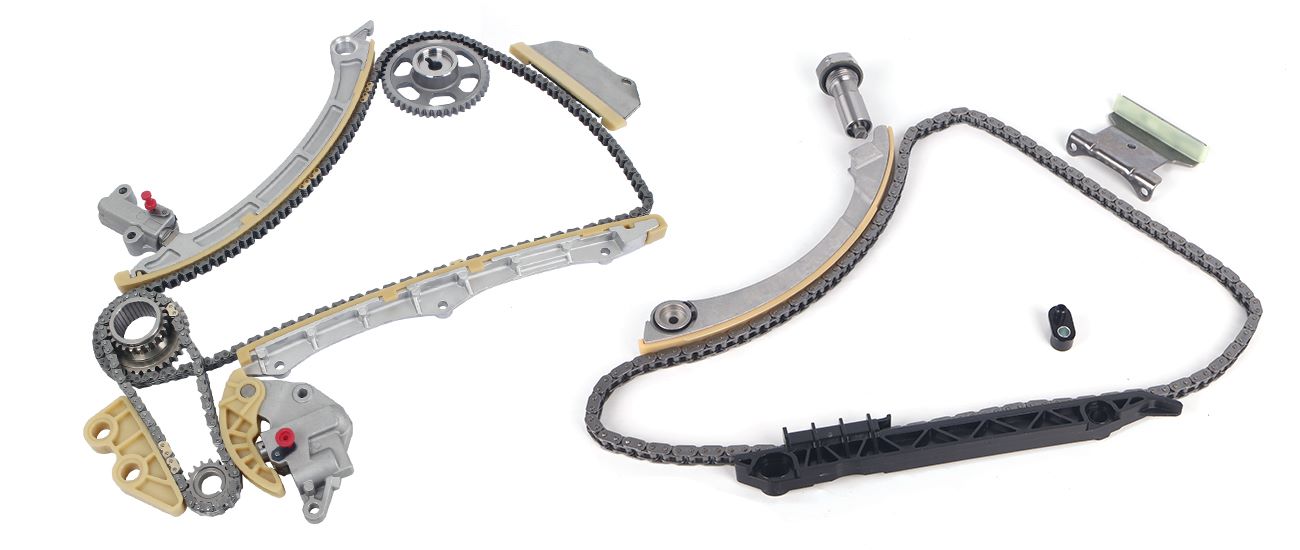
A timing chain runs in engine oil inside the engine and is built to last the engine's life. In practice, chains stretch, guides wear and tensioners exhaust their travel — usually announced by a rattle at start-up before the oil pressure builds. The chain kit replaces the wear set when the timing case is opened for those symptoms. Demand arrives as jobs rather than intervals, which is why chain kits are stocked by application groups a factor's workshops actually see.
How applications split
No engine takes both. The split is by engine family: each engine design uses one drive, and the parts catalogue for the engine shows which. Buyers confirming an application should use the engine code, because model names often span both drives across a range's life — one engine in a model line is belt-driven while its stablemate is chain-driven, and the badge on the car does not say which is under the cover.
| Point | Belt kit | Chain kit |
|---|---|---|
| Demand driver | Service interval reached | Symptom found on inspection |
| Forecasting | By parc and interval | By workshop job flow |
| Kit logic | Replace the whole wear set on schedule | Replace the whole wear set once opened |
| Confirmation | Engine code or schedule | Engine code or timing drawing |
The conversation at the counter
Most counter confusion is a customer asking for 'a timing kit' with the drive unstated. The one-question discipline — belt or chain, settled by the engine code — prevents the only serious error in this category: a kit that cannot fit the engine at all. The comparison guide on this site sets the checks out in the order a buyer meets them, and both family pages cross-reference it.
Failure economics: why the kit logic differs
The two kits also insure against different failures. A belt that lets go usually does so without warning at the end of its material life, and on an interference engine the result is bent valves and a bill many times the kit's price; the scheduled kit is cheap insurance bought on a calendar. A chain rarely lets go outright — it announces itself, through rattle and through the tensioner's diminishing ability to hide the stretch — and the kit is bought to close the job properly once the announcement has been heard. Buyers explaining the difference to their own customers find the insurance framing settles most arguments about why the whole set is replaced in both cases.
For the factor, the practical consequence is that belt kit demand can be forecast from the parc and chain kit demand cannot — it can only be answered quickly. Stocking policy follows: depth where the calendar drives demand, breadth and a fast quotation desk where the symptom drives it.
Mileage patterns sharpen the picture further. Belt intervals are written in miles and years, so a parc's belt demand arrives in waves that follow its original sales years — a factor can literally read next year's belt shelf from registration data. Chain demand follows no such curve; it follows the age at which each engine family's chains begin to stretch, which the workshops learn engine by engine and the factor learns from them. The two families reward different kinds of knowledge, and the buyers who handle both well keep the two kinds in separate conversations.
One badge, two engines: the everyday case
Consider the case that causes most of the trouble. A popular model line runs for a decade. Its smaller petrol engine is belt-driven; its diesel is chain-driven; a later petrol flagship goes back to a chain. A workshop orders 'a timing kit' for the model and year, and three different answers are possible depending on which engine is under the bonnet. The year does not settle it. The badge does not settle it. Only the engine code does — and the same pattern repeats across nearly every manufacturer's range, because engines are shared, swapped and revised on their own calendar, not the body's.
The application lists at a good factor are therefore filed by engine, with the model as a cross-reference — the reverse of the filing most customers expect. When a customer asks by model, the counter's job is to walk the question one step further to the engine before quoting. That single step is the difference between a timing shelf that earns its space and one that generates returns, and it is why both family pages on this site lead back to the same confirmation guide.
Stocking the two families together
Factors serving general workshops usually hold belt kits deeper than chain kits, because belt demand is broader and more predictable, and hold chain kits against their top engine applications. Both families are quoted from this catalogue, and an application list sent for pricing comes back split by drive so the two shelves can be planned separately.