Axlevara · blog range
UC vs UCF insert bearings: which form for which buyer
The UC insert presumes a housing; the UCF brings its own flange. Why agricultural and industrial buyers split between the two forms.
- Range
- UC versus UCF
- Catalogue
- Family 7: inserts
- Reference
- Insert alone or flanged unit
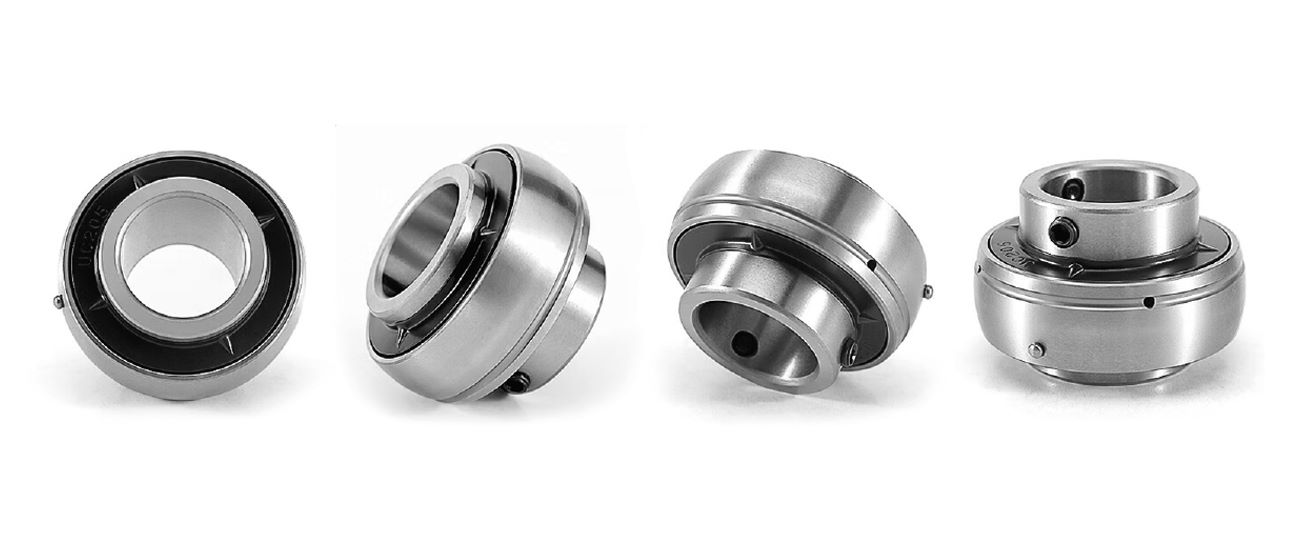
The same bearing in two arrangements
UC and UCF are not rival designs; they are two arrangements of the same idea. Both are ball bearing inserts with a spherical outer surface that tolerates shaft misalignment. The UC is the insert alone, made to seat in a housing the machine already has. The UCF carries the insert in a flange that bolts to a flat face. Choosing between them is choosing what state the mounting is in — and that is why different trades lean different ways.
The choice also has a geography. Regions where agricultural machinery is serviced on-farm, by the owner, with a press in the barn, are UC country to the core: the insert is the order, the housing is furniture. Regions where machinery goes to a dealer workshop with booked hours lean UCF, because the unit's completeness is worth more than the insert's saving when the hour is metered. A supplier reading an inquiry list can sometimes tell which world the buyer works in before the form is even stated — and should still ask, because the exceptions are exactly the orders that go wrong.
The UC insert: for a sound housing
Where a machine's housings are durable and the bearing is the consumable, the UC insert is the economical order: the housing stays, the insert is pressed out and replaced, the shaft is locked by the insert's screws. Agricultural machinery is full of this arrangement, and the agricultural trade's stock lists are written in UC codes — UC200 and UC300 groups carrying most of the demand, across the code span the company's catalogue tabulates.
The UCF unit: for a face and a whole replacement
Where the mounting is a flat face, or the housing is as worn as the bearing, the UCF unit replaces everything in one bolting operation. Conveyor and general industrial buyers lean to UCF for the labour saving: four bolts, one unit, no press work, no judgement about whether an old housing deserves another bearing.
The buyers, side by side
The split is visible in who holds which stock. Agricultural dealers hold UC depth, because their customers' machines hold housings worth keeping and their workshops press inserts as routine work. Industrial factors hold UCF breadth, because their customers replace units during short shutdowns and cannot spend the window on bearing surgery. Neither is wrong; each matches its customers' labour economics.
| Point | UC insert | UCF unit |
|---|---|---|
| Supplied as | Bearing insert only | Insert in a bolt-on flange |
| Presumes | A sound housing on the machine | A flat mounting face |
| Fitting work | Press out, press in, lock screws | Unbolt, bolt on |
| Typical buyer | Agricultural dealer | Industrial factor |
Crossing between the forms
The forms share their code logic and bore steps, so a buyer can serve an application from either shelf when the mounting allows. What cannot be assumed is the mounting itself: an inquiry that says only the code leaves the desk to guess whether a housing exists. One word — 'insert only' or 'flanged unit' — closes the question, and the family page's series split keeps the two answers priced separately.
What goes wrong when the form is guessed
The insert family's ordering errors are almost all form errors. A UC insert arrives for a machine whose housing was scrapped with the old bearing, and the job stops until a housing or a UCF unit is found. A UCF unit arrives where the mounting face is a casting with no flat land for the flange, and it cannot be seated. In both cases the bearing itself was right — bore, code and series all correct — and only the arrangement was wrong. That is why the form question belongs at the front of the inquiry, not in the returns process.
The desk's habit is to ask one question on every insert inquiry that does not state the form: 'is the housing being reused?' A yes prices the UC insert; a no prices the flanged unit; a 'the housing is doubtful' prices the UCF, because a doubtful housing is a housing about to be replaced anyway. Buyers who adopt the same question at their own counters find the family's small size stops being a source of small mistakes.
The agricultural season effect
Insert demand is not level through the year. Agricultural buyers order against the season: a pre-season wave as machines are serviced before work begins, then failure-driven orders in season, when a stopped machine concentrates the mind wonderfully and the nearest correct insert wins over the cheapest eventual one. The UC codes dominate the in-season trade because the housings are already on the machines in the field; a dealer who has pressed inserts for the same farms for years holds those farms' codes as a matter of course.
Industrial UCF demand, by contrast, follows shutdown calendars and breakdowns in roughly equal measure, and it values the unit's completeness over the insert's economy. A stockist serving both trades learns to read the same small family two ways — depth in UC codes before the season, breadth in UCF units all year — and that dual reading is the whole art of this shelf.
Stocking both on a small shelf
The insert family is the catalogue's smallest — 41 listings — which makes full coverage realistic for a small stockist in a way the hub range is not. A buyer can hold the UC code groups and the common UCF units together and answer most insert inquiries from stock; the family's size is its commercial charm.
It also makes the family a useful first range for a buyer new to this catalogue: the whole shelf can be learned in an afternoon, the codes are few, and the matching discipline it teaches — code, bore, form, locking — is the same discipline the larger families reward.
A final word on the locking check, because it is the one most often skipped. UC inserts in this catalogue are the set-screw form; the wider market also sells eccentric-collar and adapter forms under neighbouring codes, and a shaft machined for one locking form does not forgive another. The old insert shows its locking at a glance — screws in the extended ring, or a collar beside it — and stating it on the inquiry takes four words. Small families punish small omissions at the same rate as large ones; they merely do it more affordably.